
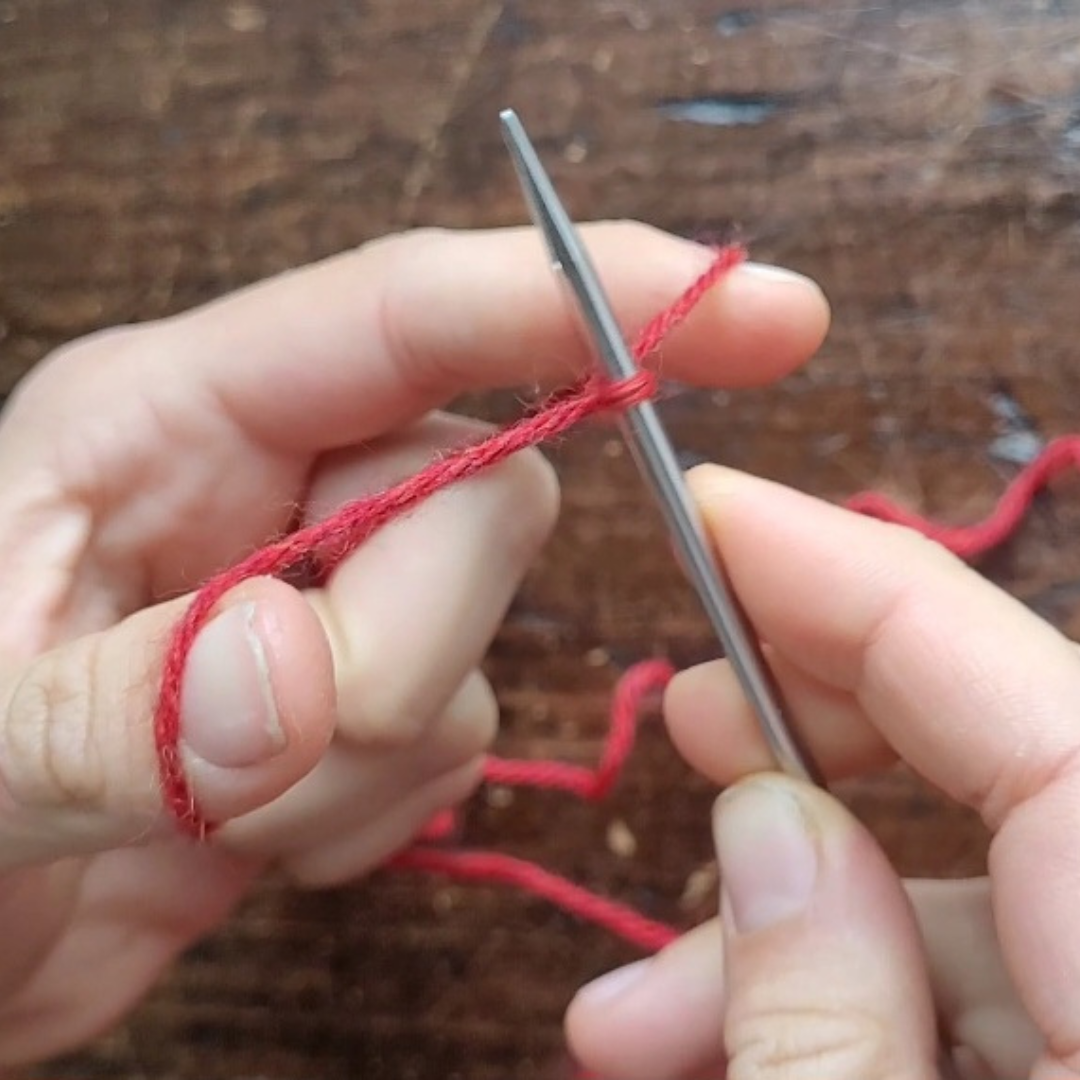
In the first newsletter I sent out, I included a tutorial on how I cast on and cast off my swatches. I thought the tutorial was worthy of sharing with all who visit the blog as well.

The Principles of Knitting by June Hemmons Hiatt is a wealth of knowledge on knitting.
It’s the size of a dictionary compared to other books I have on the subject.
Though I haven’t read it from cover to cover, I did intentionally read through her writings on knitting swatches.
She taught the Stranded Cast On and Stranded Bind Off methods as they both leave the edges of the swatch “unrestrained”.
When worked too tightly, the edges of a swatch can pull on the stitches affecting the measurements you take.
These methods keep the edges loose with minimal pulling encouraging accurate gauge measurements.
Right Twist Start
- Leaving a long tail, pinch the yarn on itself to make a loop.
- Insert your thumb and forefinger into the loop of yarn and stretch open the loop.
- Push down your needle on the top of the loop of yarn. Turn the needle to the right (counterclockwise) catching the yarn and completing the Right Twist Start.
Stranded Cast On
- Rotate needle to the left, catching underneath the yarn tensioned with the thumb. Rotate needle back over to the yarn tensioned by the forefinger catching it. Pull needle back around doing a full clockwise turn.
- Rotate needle to the right, catching yarn tensioned by the forefinger.
- Repeat steps 1 & 2 until number of stitches needed are on needle.
Note: You will need to work a stitch (knit, purl, etc.) quickly after casting on the desired number of stitches as the Stranded Cast On will unravel.
Stranded Cast Off
- When ready to cast off the swatch, cut a length of yarn to span the width of the swatch plus some.
- Thread yarn onto tapestry needle and pull through all stitches on needle, removing the needle when complete.
Note: Often, the stitches will need to be smoothed out as they will be pulled in.
Leave a Reply