
Hello everyone!
Once upon a time, I designed a knitting pattern. It was a knitting pattern for a pair of mittens.
One day, I sent the pattern to a dear knitting friend to test knit. Soon after, I received an email from her asking what needle size I recommended she use to knit the gauge swatch.
The mitten pattern used 2 different needle sizes, and I hadn’t noted in my gauge instructions which size to use.
I replied letting her know that I recommended knitting the gauge swatch with US 7 (4.5 mm) needles.
This incident, combined with my experience helping designers get their patterns ready for publishing through tech editing, has caused me to scrutinize gauge instructions.
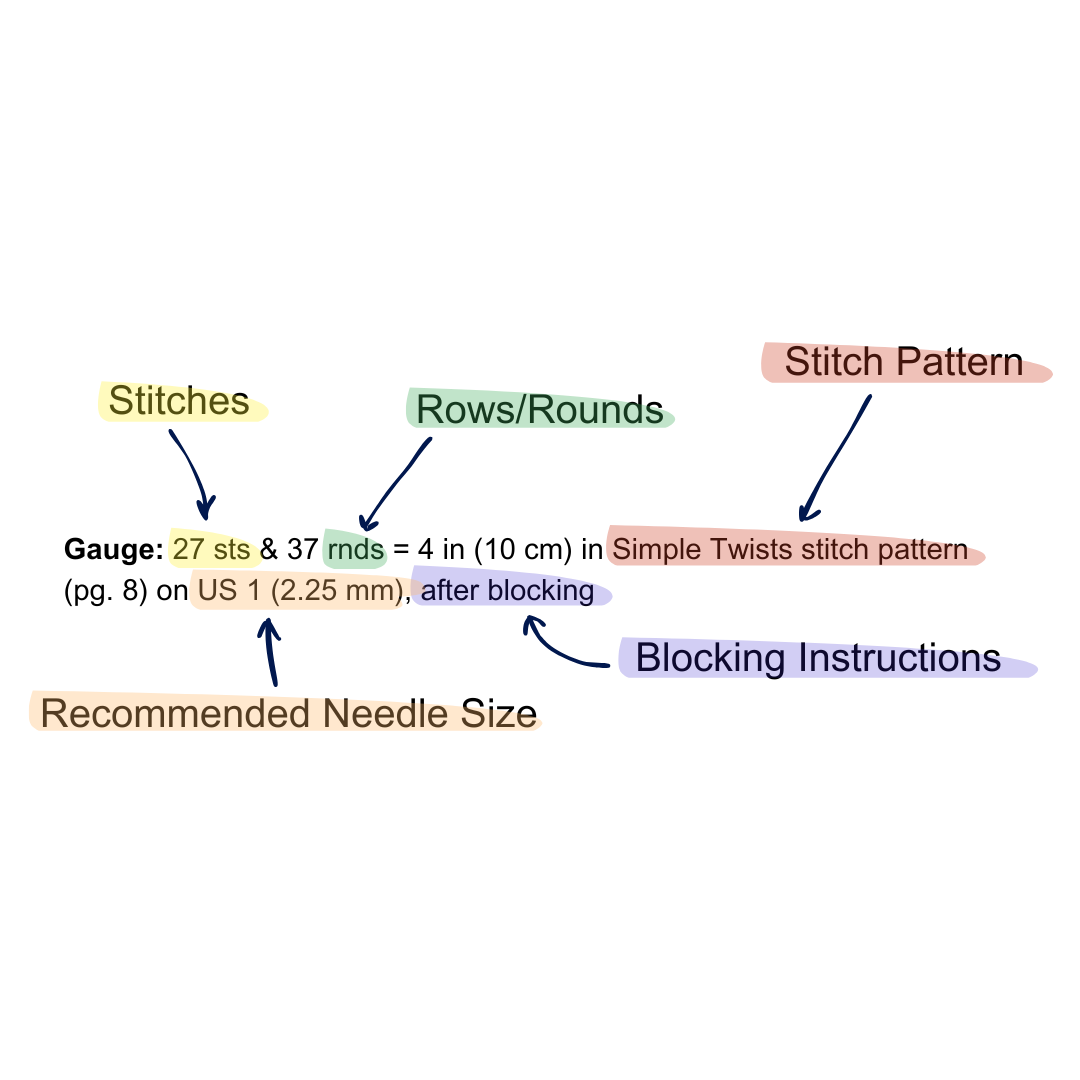
What should a knitting pattern’s gauge section include? Here are the 5 top details to list when you write your next knitting pattern.
Stitches
First, listing the number of stitches per inch/centimeter you (designer) measured in your design’s gauge swatch is necessary.
Without this stitch count, it’s close to impossible for knitters of a pattern to check that their gauge matches the designer’s.
The stitch count is most commonly listed over 4 inches (10 centimeters), but any dimension that you can measure whole stitches in will work [e.g. 1 inch (2.5 centimeters), 8 inches (20 centimeters), etc.]
Gauge Checklist
Tired of forgetting the endless details of what to list in your knitting pattern?
New to writing knitwear patterns and interested in learning more?

Maybe my free Gauge Checklist would help you. Download for free below.
Rows / Rounds
Along with the stitches per inch/centimeter, knitters will need to know the number of rows/rounds.
In my opinion, the number of rows/rounds per inch/centimeter should always be included. Read the example below to understand how impactful to the final size of a knitted item the row/round gauge can be.
For example, when a cardigan yoke is worked for a certain number of rows for raglan shaping decreases, a knitter following the pattern with a different row gauge could have an armhole depth that is too deep or too short. This is an example of how important getting gauge can be!
Like stitches per inch, the row/round count is most commonly listed over 4 inches (10 centimeters), but any dimension that you can measure whole stitches in will work.
Important Note: I want to emphasize the power of the words, rows and rounds.
Rows is the term used for knitting back and forth (flat knitting).
Rounds is the term used for circular knitting (knitting in the round).
More than identifying the direction these stitches are measured, these words should communicate how to knit the gauge swatch.
For those knitting your pattern, list rounds per inch/centimeter for a gauge swatch to be knit in the round. List rows per inch for gauge swatches to be knit flat.
Stitch Pattern
Since the same pair of needles, yarn, and hands can produce different gauge swatch measurements depending on whether the stitch pattern is stockinette or colorwork, it’s a priority to list what stitch pattern knitters should work up in their gauge swatch.
List the name of the stitch pattern (1×1 rib, twisted rib, stockinette stitch, etc.) consistently in the gauge instructions and all other pattern instructions. Don’t use the name 1×1 rib in the gauge instructions and k1, p1 rib in other areas of the pattern. Be consistent.
Suggestion from an Editor: I appreciate when a designer will note what page number that I can find the stitch pattern for swatching on. Unless on the same page, listing the page number saves me time hunting each page for the stitch pattern instructions for the gauge swatch.
Blocking Instructions
As the gauge of a swatch often changes once blocked, let those following your pattern know whether you (designer) achieved your gauge measurements from a swatch that was or wasn’t blocked.
It’s amazing how the swatch can shift in size due to experiencing water!
Recommended Needle Size
The needle size recommended to knit the swatch can be super helpful to include.
I find it frustrating when I work from a pattern that doesn’t recommend a needle size to swatch with if the pattern uses multiple sizes of needles.
A recommendation is a great starting point.
Important Note: I find it helpful when designers kindly remind us that we can adjust the needle size if we can’t match the listed gauge with the recommended needles. More experienced knitters may not need this reminder, but some appreciate it greatly.
Do you think the gauge section of a pattern should recommend a needle size? What do you include in your pattern’s gauge instructions? I would love to hear your opinions!
Leave a Reply