
Hello everyone!
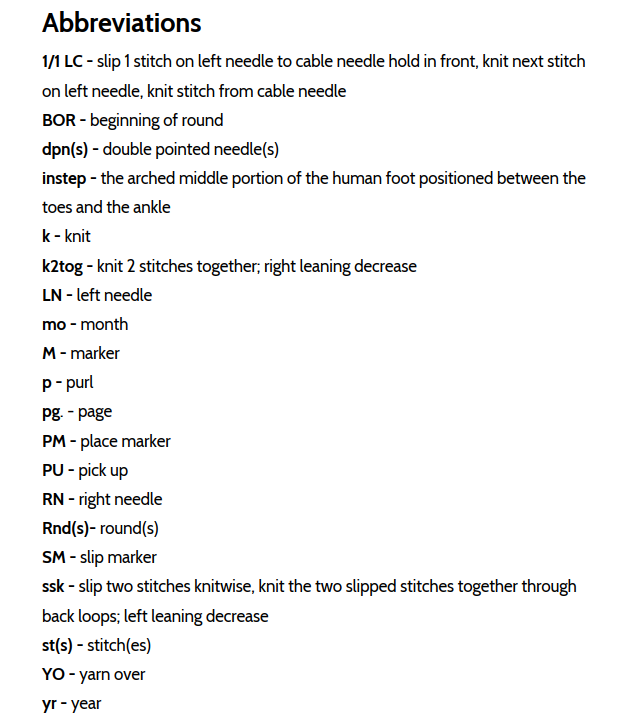
Abbreviations! Most knitting patterns I encounter use “K2tog” instead of “knit two together”, “YO” instead of “yarn over”, and so on.
Abbreviations allow us to shorten the length of a knitting pattern.
For some patterns, if the word “knit” is used 100 times in the instructions, writing the abbreviation “K” instead of “knit” can cut out 300 letters.
Also, abbreviations are very familiar and can make a pattern feel like home to some knitters.
I have old knitting patterns from my late great-grandmother which are bursting with abbreviations making some of them appear like a puzzle compared to many patterns I’ve seen published in recent years.


To Use or Not
Do knitting patterns need to include abbreviations? No, there are no rules or standards that state a knitting pattern must include abbreviations.
Benefits of Using Abbreviations in Patterns
There are several benefits to using knitting abbreviations.
Reduce text size and length of pattern
I’ve spent endless hours editing academic papers trying to remove unnecessary words or change redundant ones.
Using abbreviations for commonly used words in a knitting pattern like “dec” (for decrease) and “incr” (for increase) is an example of how using abbreviations can make pattern instructions more concise.
Tradition
My grandmother’s patterns are full abbreviations. Abbreviations can be included simply to keep the tradition of using them in knitting patterns alive.
Knitter’s preference
A knitter may prefer to see “K2tog” instead of “knit 2 together” in pattern instructions. The pattern user’s preference is a valid reason to include (or not include) abbreviations.
Negative of Using Abbreviations in Patterns
Though there are many pros to using abbreviations, there is a big con to be aware of.
Screen readers don’t read knitting abbreviations correctly
When I wrote my first knitting pattern filled with abbreviations, I was unaware that using abbreviations made my pattern difficult or impossible for print-challenged and blind knitters to use.
A screen reader would likely speak a confusing sound when trying to read the abbreviation for “slip, slip, knit,” “ssk,” reading an odd sound instead of how knitters usually pronounce it, “s-s-k.”
Knitters with visual impairments may struggle to read an abbreviation or read back and forth from an abbreviation to its meaning, often located in another section of the pattern.
Overall, patterns using abbreviations can be inaccessible to many.
That’s why I decided to write a low-vision accessible version of all my patterns, free from abbreviations.
If you are an aspiring knitwear designer, whether you use abbreviations in your pattern or not is a personal decision not a right or wrong.
For those who choose to utilize abbreviations, take the following sentence to heart.
Include an abbreviations list to explain the meaning of each abbreviation used.
Tips
If you are writing a knitting pattern, consider these questions when including abbreviations.
- Are all abbreviations used in the pattern listed in a list with a short description of what each abbreviation stands for?
- Is each description detailed enough for a knitter to understand how to work the stitch?
- Are more involved stitches described elsewhere in the pattern or linked to in a tutorial?
Abbreviations & Special Techniques Checklist
Tired of forgetting the endless details of what to list in your knitting pattern?
New to writing knitwear patterns and interested in learning more?

Maybe my Abbreviation & Special Techniques Checklist would help you. Download for free below.
When I tech edit a knitting pattern, I will go through the following details to verify that no errors or confusion are caused to a knitter due to an abbreviation:
- Does the pattern contain any abbreviations?
- If abbreviations are used, is there a list of abbreviations?
- Are all abbreviations used in the pattern present in the list?
- Generally, are all abbreviations in the list used in the pattern? Like a magazine, a designer can include a full list of every abbreviation ever used in every pattern, though it would be lengthy for a single pattern. I will check and note any extra abbreviations as just a couple of unused abbreviations in the list could cause confusion.
- Do any abbreviations sound like they need more explanation or a tutorial? This wouldn’t be “k2tog” but more detailed or unique stitches like cables or stitch patterns the designer created.
- If tutorials are linked, do the links work correctly? Does the URL send knitters to the correct website?
- Are there any missing instructions needed to work the stitch? Mentally, I try to work the stitches as if I’m knitting them.
Abbreviations, and their fellow list, can be common attributes of a knitting pattern.
When done well, they can create a compact layout and simplified experience with a pattern for knitters.
Abbreviations have to be executed well to be a helpful component of a pattern!
What are your opinions on abbreviations in knitting patterns? Do you like patterns that use abbreviations? Do you see ways knitting patterns could be improved in the use of abbreviations? Comment below if you so desire.
Leave a Reply